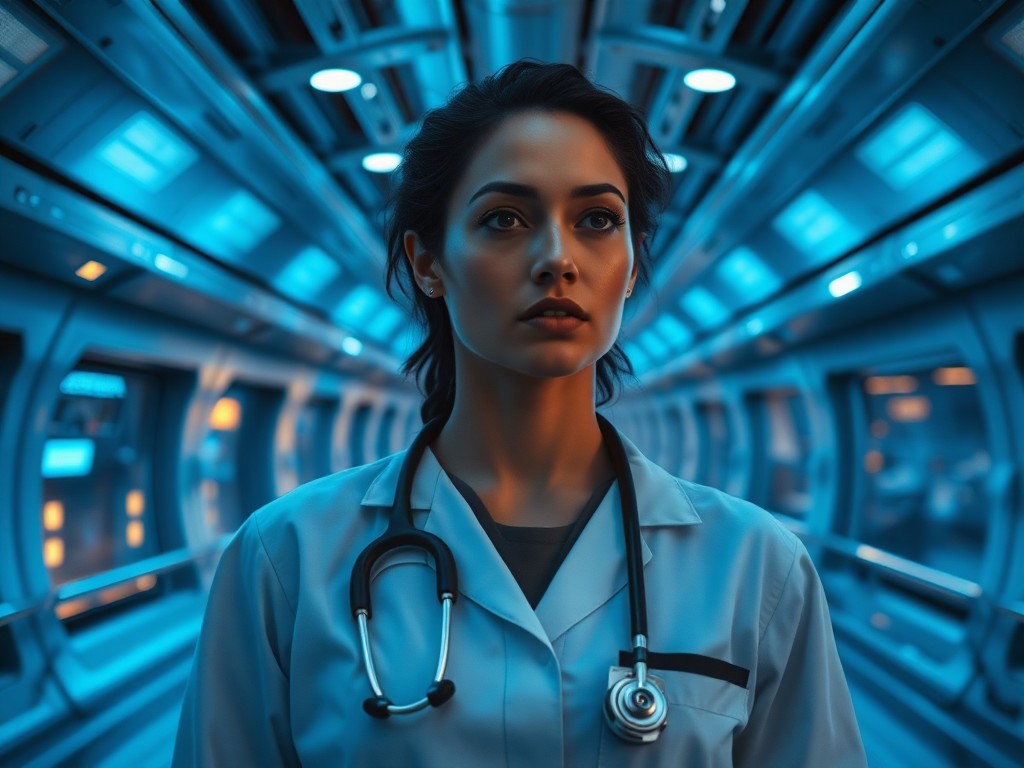
The promenade's night cycle washes everything in cold blue light as you retrace your steps toward the Starboard Lounge. The two technicians left twenty minutes ago — but station habitats are finite. People don't vanish. They go somewhere.
You find them.
They're in a service alcove off the main concourse, two junctions down from the lounge. The portable terminal glows between them, casting sharp white light across their clean-shaven faces. One of them — younger, blond hair cropped military-short — is speaking in clipped phrases you can't quite hear. The other, older and heavier, nods and taps the screen.
You slow your pace. Casually. The way a doctor walks a night shift — unhurried, purposeful, invisible through sheer routine.
It doesn't work.
The younger one's eyes snap to you mid-sentence. His hand moves with trained precision — not to a weapon, but to the terminal. A keystroke. The screen goes dark. The conversation dies as if someone had cut an audio feed.
They know you were watching.
The older one straightens, and his expression shifts from surprise to something colder. Calculation. He steps forward, deliberately blocking your line of sight to the alcove.
"Can I help you?" His voice is flat. Professional. The kind of polite that carries a warning underneath like a blade under a napkin.
You open your mouth — an explanation, a deflection, something — but your instincts are clinical, not covert. You read patients, not suspects. The lie that forms on your tongue is too slow, too obvious.
"I was just—" you begin.
"You were just leaving," he finishes. Not a suggestion. "This is a maintenance corridor. Passengers use the main concourse."
The younger one is already packing the terminal into a hardshell case. His movements are quick but controlled — no panic, just efficiency. These aren't nervous civilians. They're trained, and you've just identified yourself as someone who notices things.
The older one doesn't move aside. He's not threatening, exactly. He doesn't need to be. His posture says everything: You don't belong here. Walk away. Now.
"Nice badge," he adds, glancing at your medical pin. The words are light, but his eyes aren't smiling. "If you're looking for patients, the infirmary is on deck four. Good night, Doctor."
He steps back into the alcove. The conversation is over.
You walk away. Your pulse is elevated — not from fear, but from the sharp, sour taste of a blown opportunity. You moved too soon. Too directly. A medic's instinct is to approach and assess, not to shadow and observe. You're not a spy, and tonight that showed.
Behind you, you hear the soft hiss of a service door cycling. When you glance back, the alcove is empty. They're gone — through a maintenance access you don't have clearance for, into the station's infrastructure layer where passengers never go.
The lead is cold. Whoever they were, whatever they were working on, they've seen your face and your badge. They'll be more careful now. If they come back to the lounge at all, they'll watch for you.
But failure teaches. Two things linger as you make your way back toward Dock 7:
First — their reaction was disproportionate. Maintenance workers don't kill a terminal that fast for a routine schedule check. Their hands were trained, their exit was rehearsed. Corporate operatives, not technicians. The kind of people who work off the manifest.
Second — the older one called you Doctor. Not ma'am, not citizen. Your credentials registered immediately, and his response was to shut you out, not to report you. That means they didn't want station security involved any more than you do.
The information is incomplete. The door is closed. But the shape of the mystery — corporate, covert, deliberately off-grid — is clearer than it was an hour ago.
You just can't get to it. Not tonight. Not alone.
The Starfarer's airlock cycles around you with a familiar, tired wheeze. The ship smells like old metal and recycled air, and the silence of an empty vessel presses in. No engineer. No gunner. No crew. Just you, forty tonnes of lithium, and a galaxy that doesn't care whether you succeed.
You need a different approach. The bartender was right — people come to you when they need something. And the technicians proved something else: you're not equipped to chase leads alone. You need an engineer. You need crew.
Tomorrow. The hiring hall. The Starfarer's problems won't fix themselves.
Hero Status